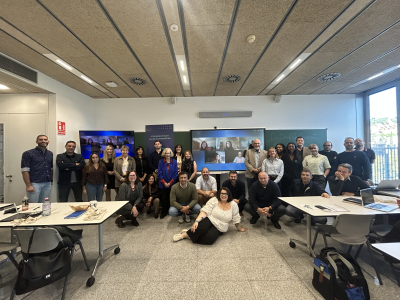
How do you build trust between police and the people who trust them least? It is difficult to do this remotely from behind a desk. Trust can be built gradually when people feel welcome and able to sit in the same room and talk together in a safe, mutually respectful and equal way, whether they are police officers, researchers, support services or people living with poverty and exclusion.
Trust is built when people listen to and care about each other’s perspectives, and when people and police show that they are tolerant, kind, honest and reliable. When they show they are trustworthy.
That is what BTL-COP has spent its first year doing. In October, the consortium travelled to Spain to mark the project’s first anniversary. The week began with visits in Madrid, continued with our third General Assembly in Barcelona and ended at the 4th International Conference on Aporophobia.
This issue follows that week: what we saw, what we agreed, and what comes next.
Madrid: learning from the front line
On 19 and 20 October, partners met in Madrid with institutions working where security and inclusion meet.
The programme opened at the Ministry of the Interior’s National Office for Combating Hate Crimes (Oficina Nacional de Lucha contra los Delitos de Odio, ONDOD). Discussions focused on how police can recognise and respond to crimes driven by hostility towards people in poverty.
Partners then visited the Pedro Meca shelter, where they heard how services and support for people experiencing homelessness in Madrid are organised. This included an overview of homelessness in the city, the different shelters and the levels of access and service they offer. The sessions were led by Silvia Feijoo Escudero and Yolanda García Fernández of Madrid’s Department for the Prevention of Homelessness and Care for People Experiencing Homelessness (Departamento de Prevención del Sinhogarismo y Atención a Personas Sin Hogar). The day ended with a short showcase of the BondMate pretotype and an afternoon focus group to gather feedback on the device.
On 20 October, partners visited the San Cristóbal Market School. Deputy Inspector José Ramón Gonzalez Inocencio presented Madrid Municipal Police’s programme for young people, which includes school visits and officers dedicated to patrolling and supporting young people across the city. Partners also heard how Madrid Municipal Police works with young migrants and refugees, explaining their rights, cultural differences and the Spanish legal system. The aim is a supportive environment where these young people feel welcome and can build trust in the police. Partners then sat in on one of these sessions with students of the trade school, brilliantly led by Officer Juan Perez.
None of this would have been possible without the brilliant organisation of our colleague Ivan Garcia San Juan of Madrid Municipal Police.
Madrid is one of BTL-COP’s four pilot regions, alongside Valencia, London and Croatia. What partners heard there will feed directly into the training and pilots that start in Year 2.
One year in, the whole consortium in one room
On 21 October, partners met at La Salle Campus Barcelona (FUNITEC) for BTL-COP’s third General Assembly. The meeting was chaired by Professor Jill Jameson, Project Coordinator, University of Greenwich (part of the London and South East University Group), together with the Project Management Committee.
Each work package shared its Year 1 highlights. The Advisory Board members present then gave their reflections on the first year and their strategic recommendations. Partners reviewed Year 1 progress, agreed the Year 2 implementation plan, and approved police curricula development (WP4) and the next phase of dissemination and communication.
The same day, STEMwise led a Key Exploitable Results (KER) validation workshop. It tested which BTL-COP results can live on after the project and who will take them forward.
In the afternoon, Etienne and Beverly Wenger-Trayner, world experts in communities of practice and social learning, led the final session of the General Assembly. Their workshop was on Boundary Structure, Community of Practice, and the Future of TING. Police officers, researchers, technology partners and community organisations worked side by side on how BTL-COP’s Trust in Neighbourhood Groups (TING) model can grow into a community of practice that crosses professional boundaries and lasts beyond the project.
“BTL-COP has had an excellent first year: we are very pleased with the progress made. I would like to thank all partners and collaborators for the fantastic support you have provided in coming together to build trust and leadership for safer communities.” Professor Jill Jameson, Project Coordinator (University of Greenwich)
Jill’s leadership was also recognised this year. She received the Research and Knowledge Exchange award at the University of Greenwich Staff Awards 2026 for her longstanding partnerships with Second Wave, the Metropolitan Police and European organisations, and for their impact on community policing. Congratulations, Jill!
Year 1 at a glance
All Year 1 deliverables and milestones were completed on time. Here’s what that work produced:
Evidence base
Trust Measurement Framework (D2.3), Community Policing Review (D2.1), Observatory Workshop Framework (D2.5; Milestone 3); Trust Baseline Assessment completed (Milestone 4)
Technology
BondMate pretotype completed (Milestone 5)
Community of Practice
Security Helix launched (Milestone 1); 743 experts from 283 organisations in 44 countries (21 October 2026)
Exploitation
Exploitation Plan (D7.1) delivered; Key Exploitable Results list agreed (Milestone 2)
Communication
Dissemination and Communication Plan (D6.1); 9,934 LinkedIn impressions, 1,614 content clicks, 163 followers (17 Oct 2025 to 16 Oct 2026); five 1st Symposium recordings on YouTube
Research under way
A systematic review of aporophobia and crime reporting covering more than 7,500 papers, feeding the Crime Scoping Review (due March 2027)
Public reports will be published openly on Zenodo after the mid-term review.
The Security Helix: a community built to last
Trust between police and communities cannot be built by one project alone. That is why BTL-COP set up the Security Helix, an open innovation community on the Crowdhelix platform, led by Crowdhelix.
In twelve months, the Security Helix has grown to 743 experts from 283 organisations in 44 countries. Its members include police forces, universities, research centres, NGOs, technology companies and policymakers working on civil security.
The Helix is also how BTL-COP reaches beyond its own consortium:
- Clustering with EU projects: 36 EU-funded security research projects were mapped, and all 36 coordinators were invited to join the Security Helix.
- Sister projects: joint work is under way with sister projects KOBAN and TRILLION.
- Matchmaking: the Crowdhelix CL3 Matchmaking Event connected partners with organisations preparing new Horizon Europe Cluster 3 (civil security) proposals.
- Policy: BTL-COP completed a Project Policy Fiche and joined the DG HOME and REA Projects to Policy Seminar in Brussels, where the Helix directory of 36 projects was shared.
Plans for the Helix include a sister-project clustering workshop in 2027, building towards a public summit in 2028.
On the road: taking BTL-COP to Europe
BTL-COP partners took the project to more than 15 events in its first year. Among them:
- the From Vision to Impact meeting of the Europol Innovation Lab for Horizon Europe projects, in The Hague
- the CEPOL Pitch Match Innovation Forum on law enforcement training
- the 1st National Congress on Police Mediation, Security Policies and Coexistence in Teruel, Spain
- the International Seminar of Community Policing
- the CERIS Community Policing Webinar and the CERIS Workshop on Research and Innovation against Illicit Drugs
- the UCL Policing Academic Centre of Excellence Public Trust and Confidence Sandpit
- 4YFN at Mobile World Congress in Barcelona
- the 1st BTL-COP Symposium and the Critical Encounters workshop with Second Wave Youth Arts in London
What it means for police and communities
Through co-design, BondMate, a proposed alert device, is being developed, and the first pretotype has now been built.
In Year 2, BTL-COP starts developing training for police: trust-building, a Community Policing Intelligence Toolkit, leadership materials and a train-the-trainers programme. These will be tested in pilots in Madrid, Valencia, London and Croatia, led by the Croatian Ministry of the Interior.
Barcelona: aporophobia in the spotlight
On 22 and 23 October, BTL-COP partners joined the 4th International Conference on Aporophobia at IQS Barcelona. Aporophobia means aversion to and discrimination against people in poverty. It sits at the heart of BTL-COP because it shapes how people in poverty are treated, and whether they trust police enough to report crime.
Four BTL-COP papers were presented: three in a joint session, and a fourth in a separate panel.
Expanding the Concept of Aporophobia and its Implications for Hate Crime and Police–Community Relations. Professor Cristina Albuquerque, Wilkens Barbosa, C. Carvalho, Lisete Mónico, P. Peixoto and Ana Pinto (University of Coimbra), with Professor Jill Jameson (University of Greenwich)
Presented in the conference’s Conceptual Foundations of Aporophobia strand, this paper asks how far the concept of aporophobia should reach. It looks at what a broader understanding means for how hate crime against people in poverty is recognised and recorded, and for relations between police and the communities they serve.
“I always thought it was the poor people who commit crime”: Reconceptualising poverty, crime, victimisation, and policing. Dr Melissa Pepper and Professor Jill Jameson (Institute for Lifecourse Development, University of Greenwich)
The title quotes a former criminal justice practitioner who spoke to the team after a BTL-COP presentation. That reaction reflects a long tradition in criminology of seeing people in poverty mainly as offenders. The paper turns the lens around: most people in poverty never commit crime, but they are far more likely to be its victims. People on the lowest incomes experience 62% more personal crime and 73% more violent crime than those on higher incomes (Cuthbertson, 2018).
The paper draws on BTL-COP interviews with police officers. Their first instinct was to describe poverty as a driver of offending; as conversations went on, they recognised the greater risk of victimisation. One officer explained: “Homeless people and the people in poverty have less capacity to report crimes or incidents. They have less trust in institutions.” Another described spending two hours talking with migrants: “We try to connect… I ask them, how are you? What do you need?”
The paper points to three directions for policing: raising awareness of aporophobia, re-framing poverty as a risk of victimisation rather than only of offending, and multi-agency partnership working, which community policing teams are well placed to lead.
Unmasking the Aporophobic Toxic Leadership Myths that Intensify Poverty-Related Criminal Entrapment.Professor Jill Jameson (University of Greenwich and Lucy Cavendish College, University of Cambridge)
This conceptual paper looks at aporophobia at the level of politics. It argues that fear-based political narratives present poverty as a moral failure rather than the product of structural inequality. These narratives help justify punitive welfare and policing, and leave poorer communities more exposed to surveillance and to exploitation by criminal networks. The paper maps this as a cycle of poverty-related criminal entrapment.
In response, it proposes an anti-aporophobia education agenda: critical media literacy, evidence on how poverty and crime are really linked, and leadership development for professionals, civil servants and policymakers.
Homeless people as victims or perpetrators of offences in Croatia. Željko Karas (University of the Ministry of the Interior, Zagreb)
Presented in a separate panel (parallel session 5), this paper brings the Croatian perspective to the question of whether people experiencing homelessness are seen as victims or as perpetrators of offences.
Together, the four papers make the case at the core of BTL-COP: people in poverty need protection and trust, not suspicion.
Looking ahead to Year 2
Year 2 moves BTL-COP from research towards evidence-based practice:
- March 2027: Crime Scoping Review and Crime Pathways Report, and the first periodic report to the European Commission
- July 2027: Baseline Trust Data from workshops in all four regions
- September 2027: police training materials, including the Critical Encounters video simulation tool and the Community Policing Intelligence Toolkit
- From August 2027: local Communities of Practice set up for the pilots in Spain, the UK and Croatia
We will keep sharing results openly as soon as they are cleared.
Until next time
One year ago, BTL-COP was a plan. Today it is a consortium of police forces, universities, technology partners and community organisations from seven countries, backed by a Security Helix of 743 experts. The hard part, turning trust into practice on the street, starts now.
If you found this article useful, pass it on to a colleague in policing or community safety, and follow BTL-COP Project on LinkedIn.
Partners: University of Greenwich, Institute for Lifecourse Development (Coordinator, LASE University Group), Crowdhelix (Ireland), STEMwise (Croatia), La Salle URL – FUNITEC (Spain), ITML (Greece), Madrid Municipal Police and Valencia Local Police (Spain), Ministry of the Interior (Croatia), Technology Partners (Poland), Metropolitan Police (UK), University of Coimbra (Portugal); in-kind contributor Second Wave Youth Arts (UK).
Funded by the European Union. Views and opinions expressed are however those of the author(s) only and do not necessarily reflect those of the European Union or the European Research Executive Agency (REA). Neither the European Union nor the granting authority can be held responsible for them. Grant Agreement No 101226104.
#BTLCOP #CommunityPolicing #Aporophobia #SecurityHelix #HorizonEurope


.jpg)
.jpg)


