One of the central questions behind the BTL-COP project is deceptively simple: how can trust between police and communities be measured in a meaningful and reliable way?
The answer is not straightforward. Trust is influenced by people's experiences, relationships, perceptions and the wider social context. Yet without understanding how trust changes over time, it becomes difficult to evaluate whether new approaches to community policing are making a real difference.
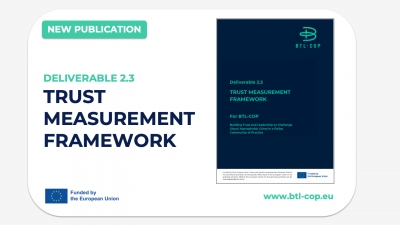
To address this challenge, the BTL-COP consortium has published its first public deliverable: the Trust Measurement Framework.
Why does measuring trust matter?
Trust is at the heart of effective community policing. When communities trust police authorities, they are more likely to report crime, share information and work collaboratively to improve neighbourhood safety. Equally, police officers need confidence that communities are willing to engage constructively in preventing and responding to crime.
Rather than viewing trust as a one-way relationship, the BTL-COP framework recognises that trust is reciprocal. It develops a novel bi-directional approach, examining both community trust in police and police trust in communitiesas interconnected processes that evolve over time.
From theory to practical evaluation
The framework brings together established research on trust, policing and community engagement with practitioner expertise from across the BTL-COP consortium. It introduces a comprehensive methodology that combines:
- validated survey instruments for both community members and police officers;
- interviews and focus groups to understand lived experiences;
- quantitative and qualitative analysis;
- a longitudinal evaluation design that measures change before and after project interventions.
This mixed-methods approach will allow the consortium not only to measure whether trust changes, but also to understand why those changes occur and which factors contribute most to successful police-community collaboration.
Supporting the BTL-COP pilots
The Trust Measurement Framework will underpin the evaluation of BTL-COP's pilot activities in London, Madrid, Valencia and Croatia. It will assess the impact of the project's trust-building interventions, including the Trust in Neighbourhood Groups (TING) approach and other project innovations, providing robust evidence to support future adoption by police authorities and policymakers.
Beyond the project itself, the framework has been designed to be adaptable across different policing contexts, creating opportunities for wider use by researchers, police academies and public authorities interested in strengthening community trust.
Looking Ahead
Publishing the Trust Measurement Framework marks an important milestone for BTL-COP. As the project's first public research deliverable, it provides the scientific foundation for evaluating how trust can be strengthened between police and vulnerable communities, helping ensure that future recommendations are supported by robust evidence rather than assumptions.
The Trust Measurement Framework is now available to download from the BTL-COP Resources page - https://www.btl-cop.eu/resources/public-deliverables/